Meaning Lies in Structure: Fine-Grained Table-Centric Document Semantic Parsing
Tables carry decision-critical quantitative evidence, but their meaning often lives in surrounding text. AITabler models table-text relationships as a five-level semantic hierarchy, integrating PDF structural reconstruction, layout-aware context retrieval, and LLM-based reasoning for table-centric document parsing and question answering.
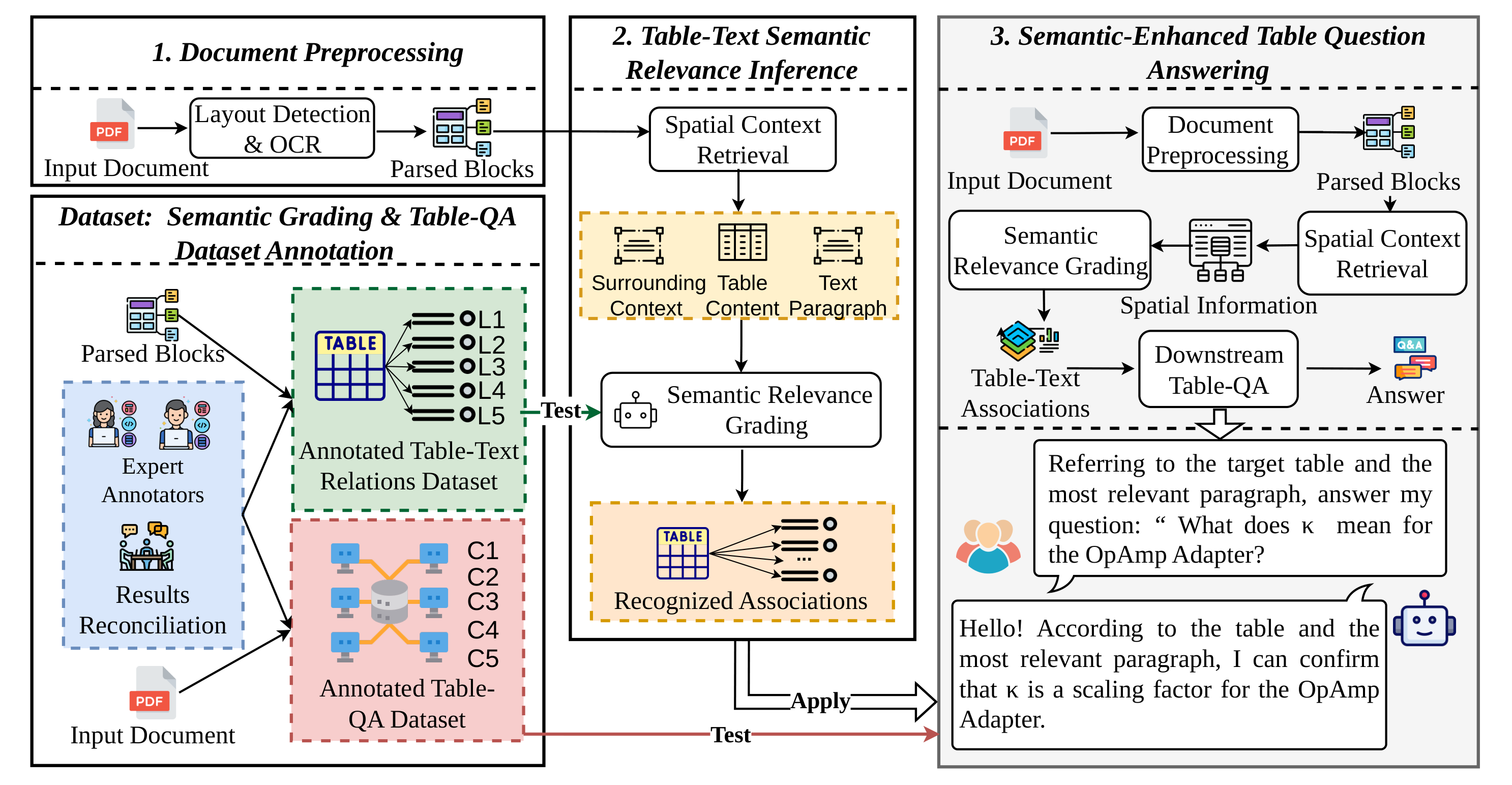
Existing PDF table research focuses mostly on visual structure recovery, while fine-grained semantic alignment across document components remains underexplored. We address this gap by formulating table-text semantic alignment as a five-level hierarchical framework and propose AITabler, an end-to-end system that integrates PDF structural reconstruction, layout-aware spatial context modeling, and LLM-based semantic reasoning.
We construct two benchmarks: a fine-grained relevance corpus with 29,138 annotated pairs and a Table-QA dataset with 6,000 questions, derived from over 3,000 PDF pages. Experiments show consistent improvements in relevance grading and substantial gains in downstream Table-QA.
Key Contributions
Five-Level Semantic Alignment
We model table-text relationships as a structured hierarchy, capturing caption reference, content alignment, topical match, contextual relevance, and unrelated context beyond coarse binary relevance.
End-to-End AITabler Pipeline
AITabler combines PDF structural reconstruction, spatial context retrieval, and LLM-based reasoning to recover table-text semantic associations at document scale.
Benchmarks for Parsing and QA
We release a fine-grained table-text relevance corpus and a purpose-built Table-QA dataset to support reproducible table-centric document analysis research.
Method
1. Document Structural Reconstruction
PDF pages are parsed into layout blocks so that tables, captions, and surrounding paragraphs can be represented as structured document components.
2. Spatial Context Retrieval
AITabler retrieves nearby candidate paragraphs using layout-aware spatial cues, reducing the search space before semantic grading.
3. Five-Level Relevance Grading
LLM-based reasoning assigns each table-text pair to one of five relevance levels, producing fine-grained associations instead of a single related/unrelated label.
4. Semantic-Enhanced Table-QA
The recognized associations provide high-value context for downstream table question answering, improving accuracy without indiscriminately adding noisy paragraphs.
Dataset & Results
Experiments show that AITabler reaches over 98% accuracy on strongly related samples, exceeds 75% on weakly related cases, and achieves more than 70% accuracy on complex QA tasks, substantially outperforming coarse-grained retrieval baselines.
Citation
@inproceedings{li2026aitabler,
  title={Meaning Lies in Structure: Fine-Grained Table-Centric Document Semantic Parsing},
  author={Li, Xuan and Xiao, Mengfei and Wei, Jingtian and Dong, Jialiang and Wong, Raymond},
  booktitle={International Conference on Document Analysis and Recognition},
  year={2026}
}