From Surface to Semantics: Semantic Structure Parsing for Table-Centric Document Analysis
Existing PDF analysis stops at surface-level layout and OCR. DoTabler goes one layer deeper — using tables as anchors to recover their semantically associated text, enabling table-centric document parsing and domain-specific table retrieval at orders-of-magnitude lower latency than GPT-4o.
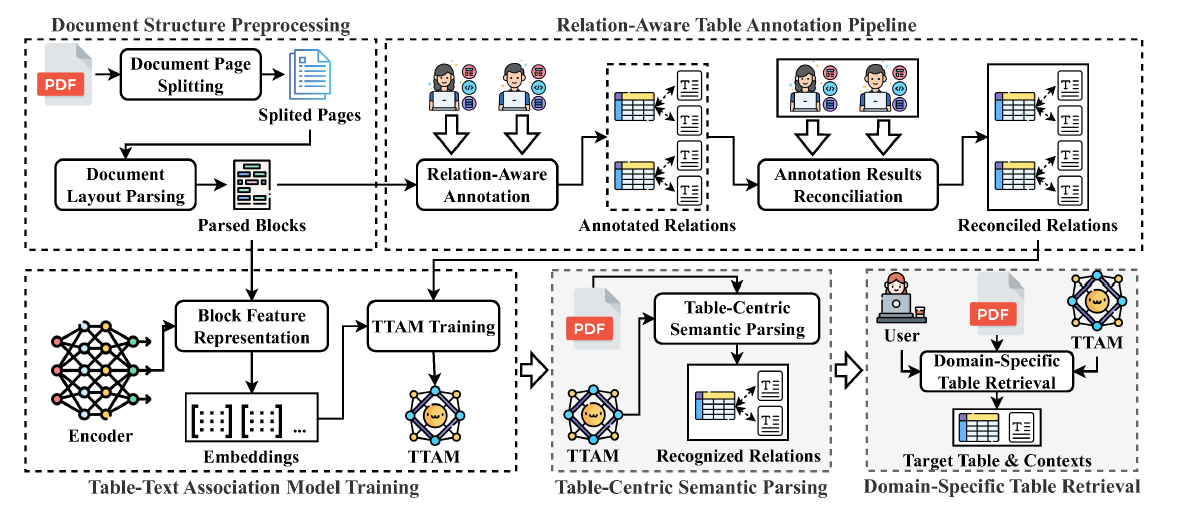
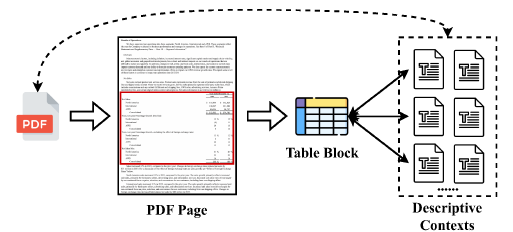
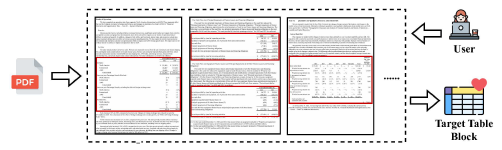
We propose DoTabler, a table-centric semantic document parsing framework designed to uncover deep semantic links between tables and their context. DoTabler leverages a custom-built dataset and domain-specific fine-tuning of pretrained models, integrating a complete parsing pipeline that identifies the context segments semantically tied to each table. Built on this semantic understanding, DoTabler delivers two core functionalities: table-centric document structure parsing and domain-specific table retrieval.
Evaluated on nearly 4,000 pages with over 1,000 tables from real-world PDFs, DoTabler achieves over 90% Precision and F1, outperforming GPT-4o, Gemini-2.0, and Claude-3.5 in table-context semantic analysis while running two orders of magnitude faster.
Two Use Cases
Key Contributions
First Table-Centric Semantic Dataset
A new PDF semantic-level dataset modeled around table-centric structures, paired with the Table-Text Association Model (TTAM) for fine-grained table–context relation analysis.
DoTabler Framework
An end-to-end pipeline that combines preprocessing (segmentation, layout, OCR) with TTAM, enabling both document structure parsing and domain-specific table retrieval in a single framework.
Comprehensive Evaluation
Evaluated on nearly 4,000 pages with 1,000+ tables from arXiv and PubMed Central, beating GPT-4o, Gemini-2.0, and Claude-3.5 on accuracy and running orders of magnitude faster.
Method
DoTabler decomposes table-centric semantic parsing into a three-stage pipeline. Each stage is modular and replaceable, making the framework extensible to new pretrained encoders or document domains.
1. Document Structure Preprocessing
Each PDF is rendered to images, segmented into pages, and passed through a Faster R-CNN layout detector fine-tuned on PubLayNet. Tesseract OCR extracts text from Text, List, Title, and Table blocks.
2. Table-Text Association Model (TTAM)
A sentence-pair classifier built on a pretrained encoder (BERT / BART / RoBERTa). For each (table, text) pair, TTAM outputs a binary "related / unrelated" label, trained with cross-entropy over balanced positive/negative pairs.
3a. Table-Centric Semantic Parsing
For every Table block in a document, TTAM scores all candidate Text/List blocks and returns the semantically associated subset, yielding a structured (table, related_paragraphs) view of the document.
3b. Domain-Specific Table Retrieval
A fine-tuned RoBERTa cross-encoder jointly encodes (query, table) pairs and produces a relevance score; tables are ranked and the top-K returned with their context. Trained with margin-based ranking loss.
Dataset & Experimental Setup
No public dataset existed for document-level semantic structure analysis with table-centric anchors, so we built the first one. Documents were sampled from arXiv and PubMed Central; two senior annotators independently labeled table-text relations and reconciled disagreements via expert consensus.
Splits. TTAM evaluation: 3,248 balanced table-text pairs split 7:3 (2,273 train / 975 test). Retrieval evaluation: 200 query-table pairs filtered to 129 train / 53 test. Baselines. GPT-4o, Gemini-2.0 Flash, Claude-3.5 — all prompted with the same task instruction so the comparison is fair.
Results
Table-Text Relation Classification (TTAM)
Document-Level & Retrieval Performance
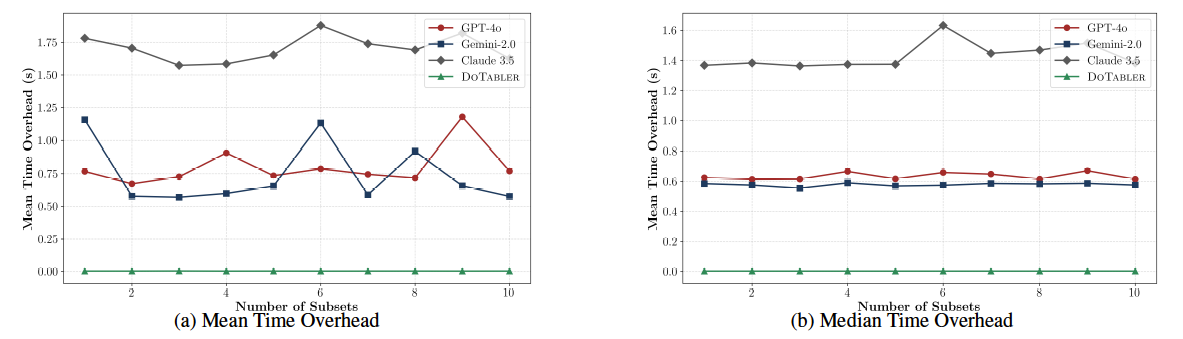
Why DoTabler wins. Decoder-only LLMs are tuned for fluent generation and adopt conservative decision strategies — they keep precision high but produce many false negatives, missing real table–text associations. RoBERTa's bidirectional encoder, fine-tuned on the new dataset, captures fine-grained contextual dependencies and is far less prone to hallucination, which is exactly what this task rewards.
Citation
Acknowledgments: This work was conducted at the University of New South Wales. We thank our annotators, Xiao Chen and Kuang He, for their careful work on the table–text association dataset.